
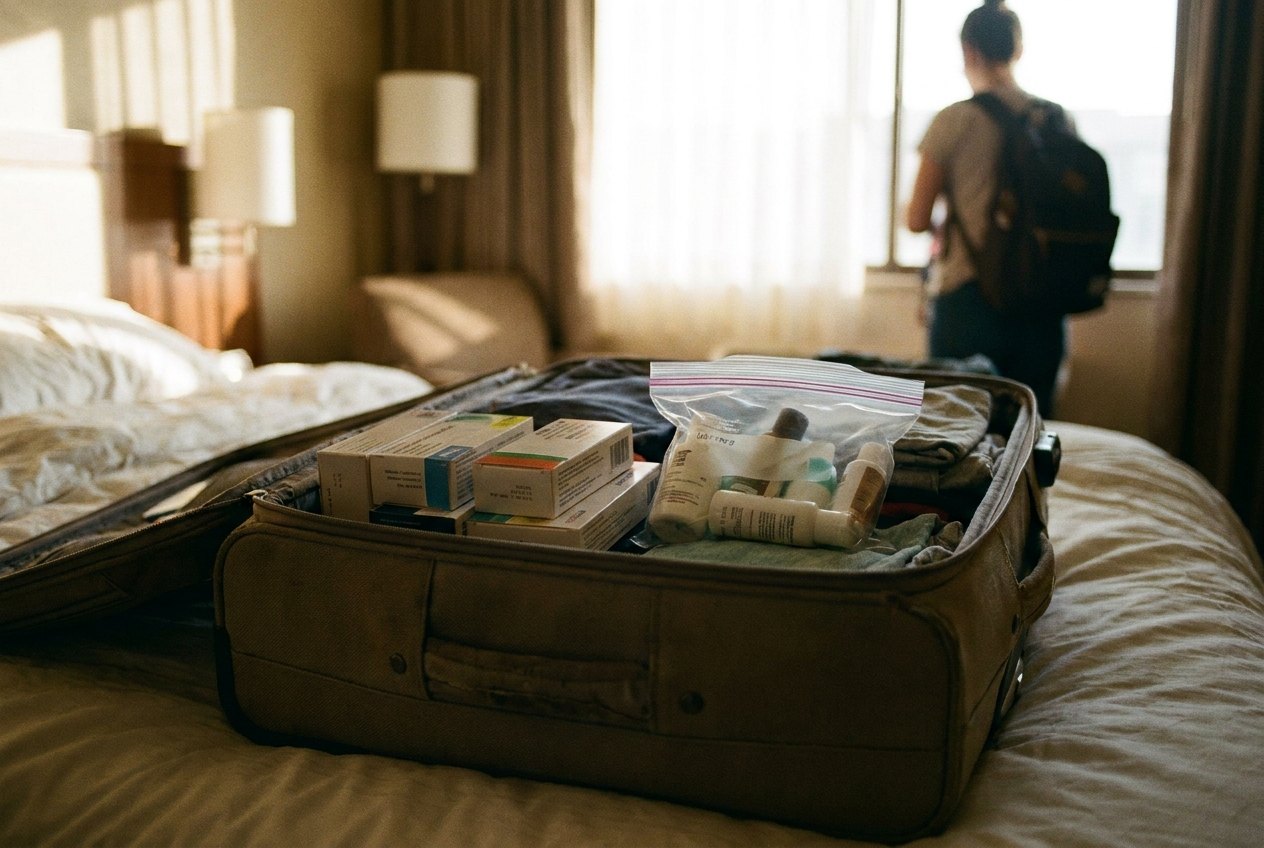
Most travellers carry some medicine: a few painkillers, a hay fever tablet, an inhaler, a course of something prescribed by a doctor. Usually this causes no difficulty at all. Occasionally it does, because the rules on what you may bring into a country vary widely, and a medicine that is ordinary at home may be treated very differently abroad.
This guide explains the general principles. It is not medical or legal advice. Speak to your doctor or pharmacist about your medicines and your trip, and keep in mind that every country on your route has its own rules, including places where you only change planes.
Why medicines can cause problems at borders
Each country decides for itself which substances are controlled. Some strong painkillers, sleeping tablets, anxiety medicines, medicines for attention conditions and some cold and flu remedies contain ingredients that are restricted in certain countries. A few countries have particularly strict rules, and some require a permit or a licence arranged before you arrive, even for medicine prescribed to you.
Officials may ask what a medicine is and why you have it. Clear packaging and paperwork usually make that a short conversation. Unlabelled tablets in a pill box, with nothing to show what they are, can make it a long one.
Finding the rules for your destination
The most reliable information comes from official bodies: the embassy or high commission of the country you are visiting, and your own government's foreign-office pages. Some countries publish lists of controlled substances and explain how to apply for permission to bring them in.
A few steps help:
- Write down the active ingredient of each medicine, not only the brand name, since names differ between countries.
- Check each destination's rules, including transit countries if you will pass through their border controls.
- If a permit or licence is needed, apply early, as processing can take weeks.
- Ask your pharmacist if you are unsure which category a medicine falls into.
Some countries also limit the quantity you may bring, often to a supply for the length of your stay. If you are travelling for a long time, ask about arrangements for getting further supplies abroad.
Packaging, prescriptions and letters
Keep medicines in their original packaging with the pharmacy label showing your name, the medicine and the dose. Carry the patient information leaflet if you can. These details let anyone, from a border official to a doctor abroad, see exactly what you are taking.
Alongside the packs, it helps to carry:
- A copy of your prescription, or a printed list of your repeat medicines.
- A letter from your doctor for controlled medicines, injectables, or anything you think may raise questions. It usually states your condition in general terms, the medicines and doses, and confirms they are for your personal use.
- Any permit or licence the destination requires.
Related guide Declaring medical conditions before you travel
Your doctor's practice may charge for a letter. Ask in good time. Store a photo of each document on your phone as well as paper copies in your bag. If your medicines relate to a condition you have declared for travel insurance, the guide to declaring medical conditions explains why keeping your insurer informed matters.
Airport security and hand luggage
Keep your medicines in your hand luggage. Checked bags can be delayed or lost, as the guide to lost, delayed or damaged luggage describes, and replacing a prescription medicine abroad is not always quick or possible. Hand luggage also keeps medicines away from the very low temperatures of some aircraft holds.
Liquid medicines often fall outside the normal liquid limits at security, as long as they are needed for the journey and you can show they are medicines. Security staff may ask to see a prescription or letter and may screen the items separately. Rules on liquids are changing at many airports as new scanners arrive.
Needles, syringes, injector pens and medical devices such as inhalers, pumps or CPAP machines can usually be carried with suitable paperwork. Tell the airline in advance about anything you need to use on board, and check how it should be packed.
Storage, time zones and spares
Some medicines need to stay cool or out of heat. A pharmacist can advise on storage and on travel cool bags or wallets. In hot destinations, avoid leaving medicines in a car or in direct sun.
Crossing time zones can make it hard to know when to take a dose, particularly for medicines taken at set times such as insulin or the contraceptive pill. Ask your doctor or pharmacist how to adjust your timings before you leave, rather than working it out at the airport.
Pack a few days' extra supply in case of delays. Some travellers split medicines between two bags in hand luggage, or carry some on themselves, so a single lost bag does not leave them without any.
Buying medicines abroad
If you run out, a local pharmacist is usually the first person to ask. Bring the empty pack or your list of active ingredients. Be cautious with medicines bought from markets or unofficial sellers, since counterfeit medicines are a real problem in some regions.
Before bringing medicines bought abroad back home, check that they are allowed. Some products sold freely elsewhere are controlled in the UK and the EU.
Planning ahead turns medicines from a worry into a small, tidy part of your packing. The guide to travel documents includes them in the list of papers to keep copies of.